14-Day Trial for $1, credited to your first payment.
ChatGPT Names the Local Business You Ask About 19% of the Time (New Data)
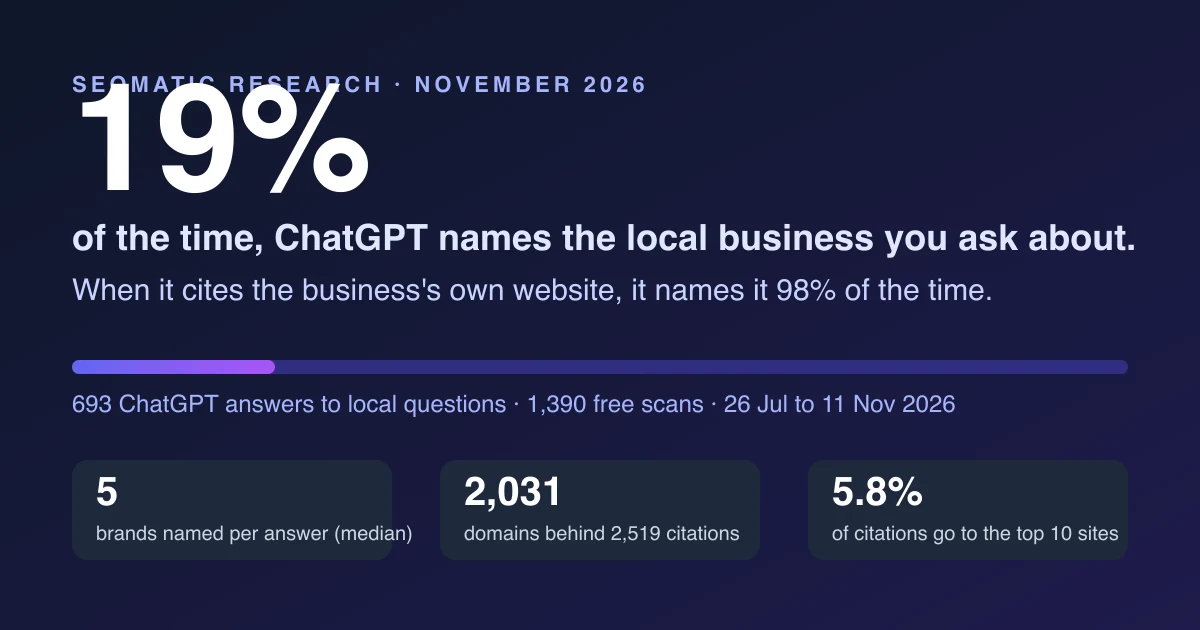
We looked at 693 ChatGPT answers to local questions from 1,390 free scans. ChatGPT named the business asked about 19% of the time, cited its own website in 14% of answers, and named it 98% of the time when it did.
ChatGPT named the business asked about in 19.3% of local answers (n=693), against 8.7% for non-local questions.
It cited the business's own website in 13.7% of local answers. When it did, it named the business 97.9% of the time. When it did not, 6.9%.
The median local answer names 5 businesses. 61% name five or more. There is no page two.
Citations are scattered: 2,519 citations went to 2,031 different domains. The top ten sites together got 5.8%.
The new Business Hub counts mentions but hides the prompts. These numbers show what a mention depends on.
On 10 November 2026 OpenAI opened Businesses in ChatGPT: a business can claim its listing, edit its details and see how often ChatGPT mentions it. The dashboard shows counts. It does not show which questions produced them or why. So we went back to our own data. Since July, 1,390 free AI visibility scans have asked ChatGPT, Claude, Google AI Overviews and Perplexity real buying questions and recorded every brand named and every source cited: 12,270 engine answers in all. 693 of ChatGPT's answers were to local questions, the kind a plumber, dentist or law firm lives on. Here is what decides whether the business is in the answer.
One Local Question, Five Businesses
A local question is one that says near me, nearby or in my area, or names a place: "emergency plumber in Austin", "best family dentist in Leeds". ChatGPT answered 693 of them in our scans, 466 from the United States. The median answer names 5 businesses (mean 5.3). 61.3% of answers name five or more. 11.5% name none at all, usually when the question was really about a how-to rather than a provider.
Compare that with a Google local result: a map pack of three, ten organic links, ads, and a second page. A ChatGPT answer is a shortlist of about five with no ads and no page two. The sixth business does not exist for that buyer.
The Business Asked About Was Named 19% of the Time
Every scan runs for one business. Across the 693 local answers, ChatGPT named that business 19.3% of the time. For non-local questions in the same scans the rate was 8.7% (n=3,577). Local questions are easier: a town and a trade narrow the field to a few dozen candidates, and ChatGPT has to pick five. In the United States alone the rate was 20.2% (n=466).
The other engines on the same local questions: Claude named the business 22.1% of the time (n=637), Perplexity 24.3% (n=140), and Google AI Overviews 4.6% (n=518). AI Overviews also returned no sources at all in 57.5% of local answers; ChatGPT did so in 7.6%.
When ChatGPT Cites Your Site, It Names You. Almost Always.
This is the number to build on. ChatGPT cited the business's own website in 13.7% of local answers (95 of 693). In those 95 answers it named the business 97.9% of the time. In the other 598 answers, where the business's site was not among the sources, it was named 6.9% of the time, and then only because another site mentioned it.
Put differently: of all the local answers that named the business, 69% cited the business's own site. Being quoted is not a nice-to-have on top of being named. For most local businesses it is how being named happens.
Where ChatGPT Reads About Local Businesses
About three in four local answers (512 of 693) came after ChatGPT searched the live web; 23 answered from memory with no search, and the rest did not report a mode. The sources it then cited are spread thin: 2,519 citations across 2,031 domains. 1,782 domains were cited exactly once. The ten most-cited sites together account for 5.8% of citations. There is no single directory to win.
Still, patterns show. 23.5% of local answers cite at least one directory, review or map site. Google properties (Maps and Business Profile pages) are the single most-cited domain, in 8.1% of answers. Behind them: review platforms such as Birdeye, B2B directories such as Clutch and GoodFirms, home-services sites such as Houzz, Angi and HomeAdvisor, the Better Business Bureau, and "best in town" list sites. Reddit, which topped our overall citation table in September, appears in only 1.2% of local answers. People do not crowd-source a plumber on Reddit the way they crowd-source software.
What This Means Now That You Can Claim Your Business
OpenAI is explicit that claiming a profile "doesn't guarantee increased visibility or give you direct control over ChatGPT's independent recommendations" (OpenAI help). The profile is where ChatGPT gets your facts right once it has decided to name you. Whether it names you is decided upstream, by what it can read and cite. In our data that is your own website first, then the handful of directories and review sites your trade actually uses.
Claim the profile if you can. Online businesses can claim wherever ChatGPT is available. Local stores and restaurants can only claim an existing US listing for now. The steps are in our claim your business in ChatGPT guide.
Make your site the page ChatGPT quotes. One page per location with the name, address, phone, hours, services, prices and policies in plain text, and OAI-SearchBot allowed in robots.txt. The 98% figure above is why.
Be on the three or four sites your trade is cited from. Not two hundred directories: the ones ChatGPT actually cites for your kind of business. Your own scan shows them.
Ask ChatGPT yourself, monthly. Business Hub tells you how many mentions. It will not tell you which questions you lose or who is named instead. Keep your own list of ten buying questions and log the answers.
Method and Caveats
Data: 1,390 completed free AI visibility scans run on seomatic.ai between 26 July and 11 November 2026, 12,270 engine answers, of which 693 are ChatGPT answers to local questions as defined above. Each scan asks three questions per engine about one business. The sample skews toward businesses that chose to run a scan, mostly in the United States (466 of the 693 local answers), then India, the United Kingdom, Canada and Australia. Answers were recorded once; ChatGPT's answers vary from run to run, so a single business's result is noise and only the aggregates are reported. No scanned business is named here. Every figure is free to cite with a link to this page.
Frequently Asked Questions
See whether ChatGPT names your business
A free scan asks ChatGPT, Claude and Google AI Overviews your buyers' questions and shows who gets named and which sites get cited instead of you.
Type your site. We ask AI search the questions your buyers ask, then show where you show up, who shows up instead, and what to fix first.
Free. No signup. Takes about a minute.
About the author
Minh Pham
Founder, SEOmatic
I'm Minh, founder of SEOmatic. I spent seven years in finance, as an external auditor, then at JP Morgan and Bpifrance, France's public investment bank, before learning to code at 42, a coding school in Paris with no teachers. During COVID I built niche websites and online stores, and SEO is what stuck. At Miles Republic, a French startup selling race entries (then called Peyce), I worked alongside its Head of SEO on the site's SEO, including programmatic SEO: we shipped 7,000+ pages that brought in 18,000+ visits a month. In 2022 I launched SEOmatic as a content engine for SEO, bootstrapped with no investors. Since July 2026 it is a team of AI SEO agents that fix sites from their own Google data and check what worked.