Each local area page used to take us half a day to create and optimize.
With SEOmatic, we can create hundreds of pages in the same time, which helps our clients make the best use of their budget.
It's transformed how we deliver scalable SEO solutions.
Will Hawkins
Marketing Director, Digi-Business UK
Agents read your Search Console data, do the work, and prove what actually moved. You decide what ships.
14-Day Trial for $1, credited to your first payment.
Turn confused prospects into convinced buyers with our expertly designed comparison page framework.
We email you the template now, then 3 short emails on finding and keeping the pages your site needs. Unsubscribe in one click. We never sell your data. Privacy policy

Megha Goel | Last updated: October 23, 2026
This free Comparison Page Template is developed to assist you in simplifying your customer's decision-making process and also to highlight the best features of your software. Ideal for SaaS companies, this framework makes it easy for your prospects to compare features, pricing, and benefits side by side. Whether you're aiming to boost conversions or offer clearer insights, this template helps you meet your audience’s needs effortlessly.
The market is filled with multiple SaaS offerings. Your prospects do not have enough time to review all of them, which leads to a longer B2B sales cycle. A comparison page can help shorten the sales cycle by simplifying the decision-making process for your audience. It does this by providing a side-by-side comparison of different products or services, showcasing their features, benefits, and pricing. This makes it easier for potential customers to see what sets each option apart and make the best choice.
As an experienced CMO, you appreciate the need for an outstanding comparison page. But again, knowing which place to begin from is not easy at all. You may find yourself asking: What am I supposed to say on my comparison pages? In what format should the page be designed? What are the qualities of a good comparison page? We agree that creating a page that looks great, drives traffic and, highlights your product effectively is tricky.
A high-quality comparison page:
• Differentiates your company’s products/services from competitors
• Helps in making the buying process simpler for the prospect
• Enhances organic search traffic for the website
To overcome these challenges, you need a clear strategy. Ensure your comparison page is user-friendly, highlights your unique offerings, and is optimised for search engines to attract and engage visitors. Balancing these elements will help you build a comparison page that stands out and gets results.
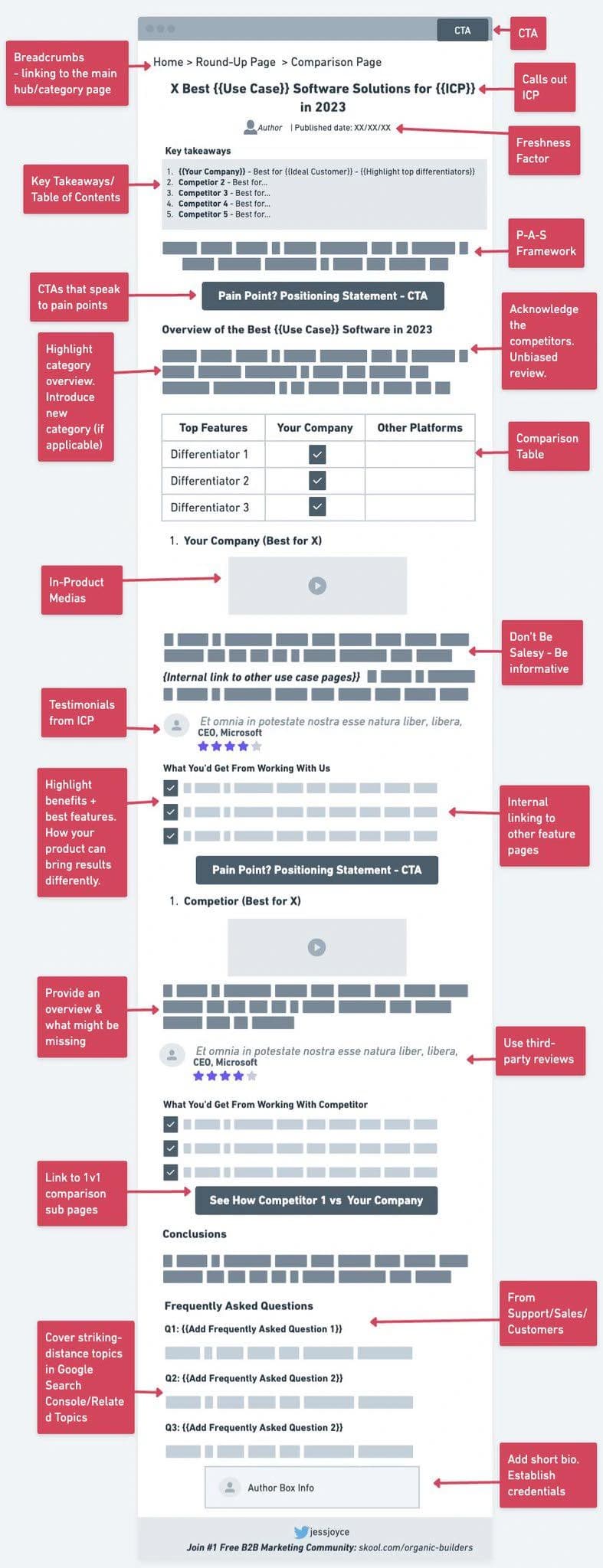
The template runs top to bottom in this order. Each block is there for a reason: search, trust, AI answers or conversion.
• Breadcrumb: Shows this page belongs to a set and gives Google the path up to your hub.
• Hero With Method, Date and Disclosure: The H1 holds the search. The line under it says how you tested and how many tools, which is what makes the page worth quoting. “We make You” is the honest disclosure Google's review guidance asks for, and readers respect it.
• Answer First: Three “best for” picks, one fact each, before anything else. Skimmers read only this. Never crown yourself best overall: pages that did were hit in Google's January 2026 update.
• Comparison Table: Rows are tools, columns are the 4 to 6 things buyers search for. Take them from your Search Console queries, not your feature list. Make it a real HTML table, never an image, and date the price column.
• Method: One short paragraph: what you tested, how, and when. Testing it yourself is the strongest proof a comparison can carry.
• Tool Sections: One H2 per tool, in table order. Each has a screenshot or measured result as proof, one honest con (yours too) and “Pick it if…”. You can go first if you label it as yours.
• Like-for-Like Pricing: Price one scenario for every tool, for example 5 users billed yearly. List prices on their own do not compare, and buyers know it.
• Switcher Proof: One quote from someone who compared the same tools. Real name and company, with permission.
• FAQ: 4 to 6 questions from Google's “People also ask” and your sales calls. Answer in the first sentence. FAQ markup no longer earns a special search result, so write these for readers and AI answers.
• Set Links: Link each tool to its versus and alternatives pages. This is how a set of pages ranks together instead of one at a time.
• Main CTA After the Evidence: A small link in the hero is fine. The main CTA sits here, once the reader has seen the table and the picks.
Publish only when:
• Between 4 and 10 tools, including at least one that beats you on something.
• Every competitor fact links to its source and shows the date you checked it.
• You never label yourself “best overall”. Use “best for segment”.
The one thing that matters most: Date every competitor fact. A comparison with last year's prices costs more trust than it earns.
Table of Contents
Megha Goel
B2B Content Writer
Megha Goel is our Content Marketer at SEOmatic, combining her technical background as a former software engineer with her talent for creating clear, engaging content.
Real quotes from the agencies and teams running their SEO on SEOmatic.
Brad Vali
President @Crescent Printing
Will Hawkins
Marketing Director @Digi-Business UK
Nick Berns
Agency Owner @BlueLightWeb
Milan Motavar
Product Manager @Mastercard
Ben Farley
SaaS Founder @Salespitch
Tom Baker
CEO @Solarmate
Joseph Lee
CEO @Supademo
Swarnendu Mandal
Head of Growth @Hoichoi TV
Lauren Wong
Chief of Staff & Operations @Arphie AI
Aaron Van Beilen
Registered Psychotherapist @Self-employed