Each local area page used to take us half a day to create and optimize.
With SEOmatic, we can create hundreds of pages in the same time, which helps our clients make the best use of their budget.
It's transformed how we deliver scalable SEO solutions.
Will Hawkins
Marketing Director, Digi-Business UK
Agents read your Search Console data, do the work, and prove what actually moved. You decide what ships.
14-Day Trial for $1, credited to your first payment.
Convince more users to try your products with our free tool page template designed to showcase your product’s unique value.
We email you the template now, then 3 short emails on finding and keeping the pages your site needs. Unsubscribe in one click. We never sell your data. Privacy policy

Megha Goel | Last updated: October 23, 2026
SaaS businesses are offering their tools for free, and it’s not costing them - it’s helping them drive more traffic and build trust with potential customers.
You can do the same with our well-designed free tools page template. Built with SEO in mind, this layout helps you present your free tools in a user-friendly way. A well-structured free tools page encourages more users to try your product, increasing your chances of converting those trial users into paying customers.
A free tool page lets users access helpful tools or features without any sign-ups or extra costs. The goal is to drive more traffic by giving users a taste of your product.
With the rise of AI (like Cursor AI, ChatGPT, etc.), it's easier than ever to create small, free tools related to your product. Consider offering tools in categories like:
• Calculators (e.g., ROI Calculator, Loan Calculator)
• Converters (e.g., Currency Converter, Unit Converter)
• Checkers (e.g., Backlink Checker, Plagiarism Checker)
Now is the perfect time to build these marketing pages - because if you don't, your competitors will.
Creating a high-performing free tool pages requires collaboration between marketing and development teams. Traditionally, marketers had to depend on developers to turn their ideas into reality, which often resulted in long wait times and project delays. However, with the rise of AI, developers can now build interactive, engaging tools much faster, allowing marketers to achieve their goals more efficiently.
Three main strategies you can use when building free tools:
• Create tools that offer part of your product for free
• Develop tools that are useful to your ICPs
• Build tools that are closely related to your product
To make this process easier, we’ve developed a simple guided framework. Our free template helps you position your product as the best, organize your page, make tools accessible, and ensure a smooth user experience.
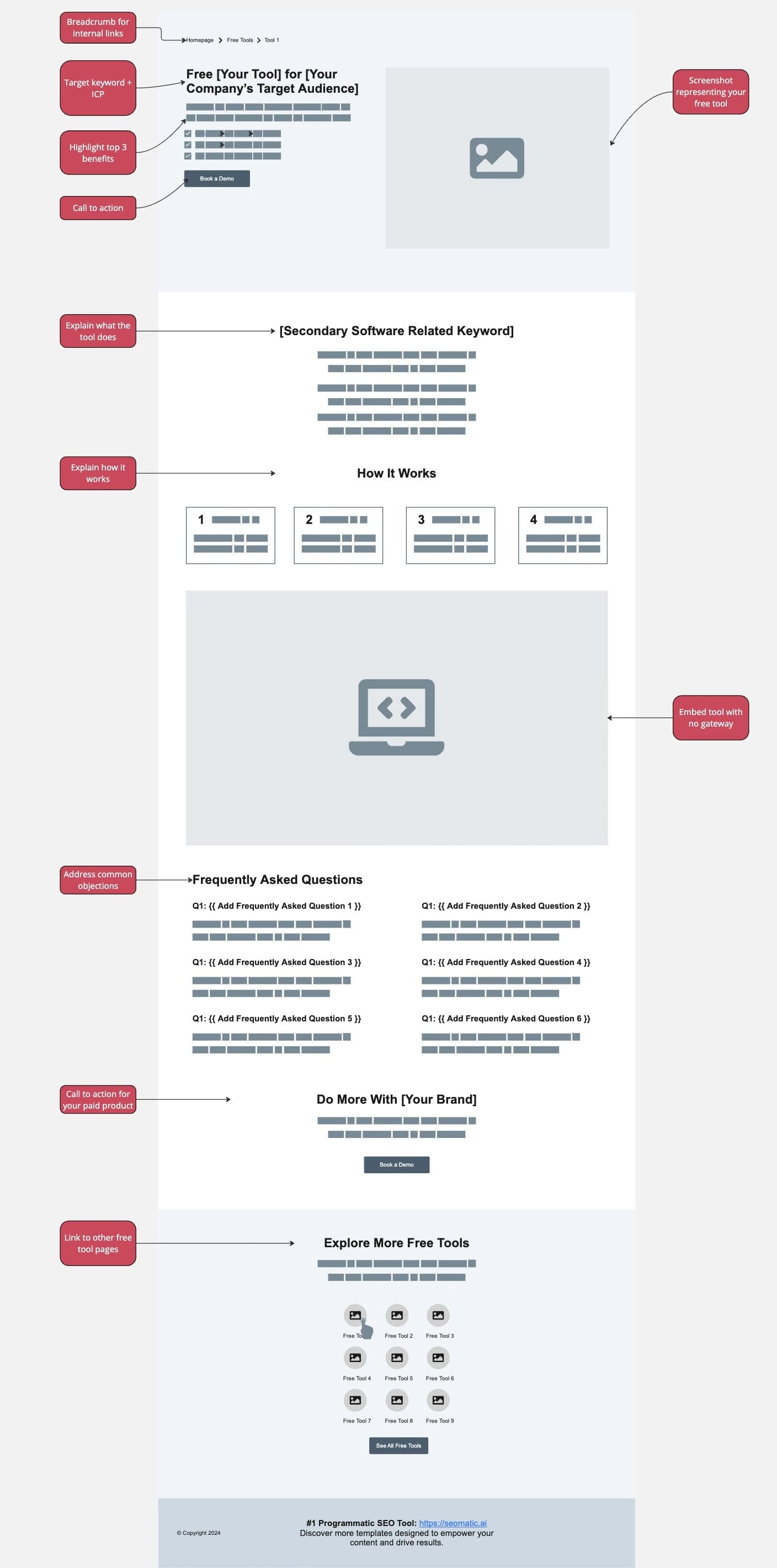
The template runs top to bottom in this order. Each block is there for a reason: search, trust, AI answers or conversion.
• Breadcrumb: Every tool sits at /tools/slug, one level deep.
• Hero: “Free” and “no signup” are the words people scan for. Keep it short so the tool shows without scrolling on a phone.
• The Tool, at the Top: The input is the first thing on the page. No pop-up, no email field before the result.
• Example Result: Show a result for a real example before anyone types. Visitors see what they will get, and Google has something to read.
• How to Read the Result: Explain each part of the result and what to do next. This text is what ranks; a tool alone looks empty to a crawler.
• Offer After the Result: The paid offer comes after the result, as the next step. An email box fits here too: “send me this result”.
• Method: How you compute the result and where the data comes from. It earns links from people who cite your tool.
• Embed or Cite: Make it easy to embed or link. That is how a free tool earns the links it was built for.
• FAQ: Answer the privacy question plainly; it is the one that stops people typing.
• Related Tools: Two or three tools for the next step in the same job.
Publish only when:
• The tool gives a result with no email or signup first.
• It uses data a chatbot cannot reproduce (live, yours, or computed).
• It works on a phone.
The one thing that matters most: The tool has to work on the page. A tool page that asks for an email before any result loses the visitor and the ranking.
Table of Contents
Megha Goel
B2B Content Writer
Megha Goel is our Content Marketer at SEOmatic, combining her technical background as a former software engineer with her talent for creating clear, engaging content.
Real quotes from the agencies and teams running their SEO on SEOmatic.
Brad Vali
President @Crescent Printing
Will Hawkins
Marketing Director @Digi-Business UK
Nick Berns
Agency Owner @BlueLightWeb
Milan Motavar
Product Manager @Mastercard
Ben Farley
SaaS Founder @Salespitch
Tom Baker
CEO @Solarmate
Joseph Lee
CEO @Supademo
Swarnendu Mandal
Head of Growth @Hoichoi TV
Lauren Wong
Chief of Staff & Operations @Arphie AI
Aaron Van Beilen
Registered Psychotherapist @Self-employed